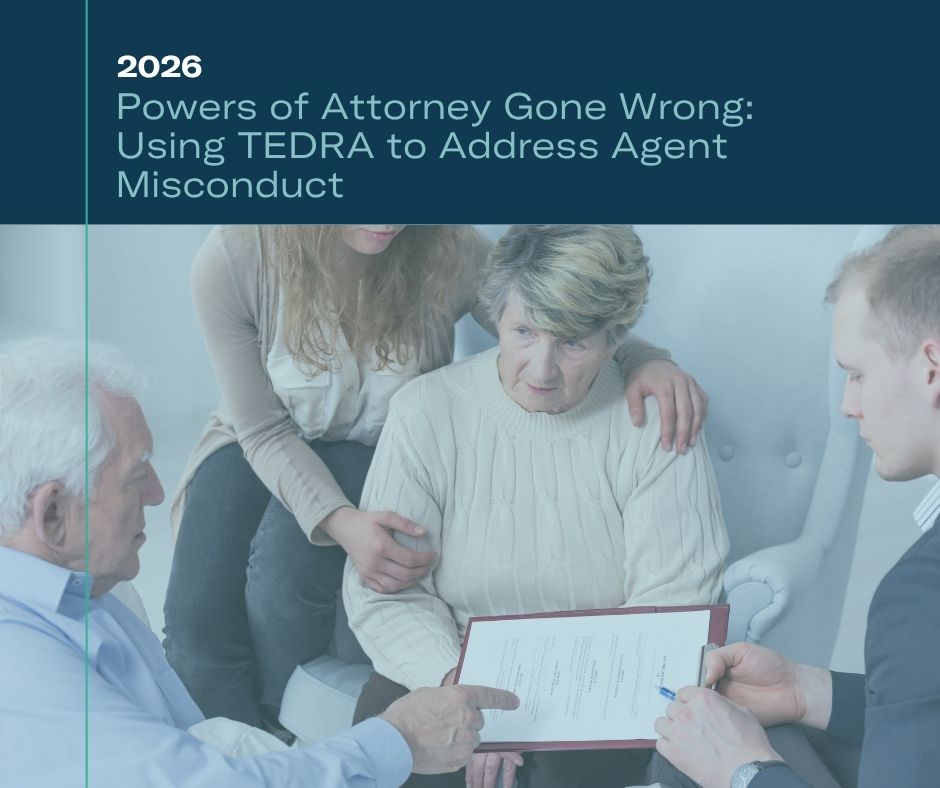
When a loved one executes a durable power of attorney, they place extraordinary trust in the person they designate as their agent. The agent gains broad authority to manage finances, access accounts, sell property, and make decisions on behalf of the principal. In many cases, this authority is exercised faithfully and without incident. But when an agent abuses that trust — whether through outright theft, self-dealing, or simple neglect — the consequences for the principal and their family can be devastating.
Washington’s Trust and Estate Dispute Resolution Act (“TEDRA”), codified at RCW 11.96A, provides a powerful and flexible framework for addressing agent misconduct. This post discusses how TEDRA can be used to hold agents accountable and recover assets that have been misappropriated or mismanaged.
The Scope of an Agent’s Duties
An agent acting under a durable power of attorney owes fiduciary duties to the principal. Under Washington law, these duties include the obligation to act in good faith, to act only within the scope of authority granted by the power of attorney, to keep the principal’s assets separate from the agent’s own property, and to maintain adequate records of all transactions. RCW 11.125.140 codifies many of these obligations, and Washington courts have long recognized that agents are held to the same fiduciary standards as trustees.
Despite these clear legal requirements, misconduct by agents is disturbingly common. Typical scenarios include an agent transferring the principal’s funds into their own accounts, using the principal’s assets to pay the agent’s personal debts, making gifts to themselves or their family members without authorization, failing to pay the principal’s bills or manage their investments, and refusing to provide an accounting when asked.
Why TEDRA?
Before TEDRA’s enactment, pursuing claims against a rogue agent often required navigating multiple statutes and court procedures. TEDRA simplified this landscape by creating a single, comprehensive framework for resolving disputes involving virtually all fiduciary relationships — including those arising under powers of attorney.
TEDRA’s advantages in this context are significant. First, TEDRA grants the superior court broad jurisdiction over “[a]ny matter involving . . . powers of attorney” under RCW 11.96A.080. This eliminates threshold jurisdictional disputes about which court or which procedural mechanism applies. Second, TEDRA proceedings are more flexible than traditional civil litigation, with streamlined notice requirements and the court’s broad equitable authority to fashion appropriate remedies. Third, TEDRA’s discretionary fee-shifting provision under RCW 11.96A.150 allows the court to award reasonable attorney fees to the prevailing party, which can serve as both an incentive for families to pursue legitimate claims and a deterrent against agent misconduct.
Initiating a TEDRA Proceeding
A TEDRA petition concerning agent misconduct is filed in the superior court of the county where the principal resides or, if the principal is deceased, where probate proceedings are pending or could be commenced. The petition typically seeks one or more of the following forms of relief: an order compelling the agent to provide a full accounting of all transactions, an order requiring the agent to return misappropriated assets, removal of the agent and appointment of a successor, a surcharge or damages award against the agent for losses caused by their breach of fiduciary duty, and an award of attorney fees and costs.
Standing to bring such a petition generally extends to the principal (if living and competent), a guardian or conservator acting on behalf of an incapacitated principal, and, after the principal’s death, the personal representative of the principal’s estate.
The Accounting: A Critical First Step
In many agent misconduct cases, the family suspects wrongdoing but lacks access to the financial records needed to prove it. The agent may have been the only person with access to the principal’s bank accounts and financial statements, particularly if the principal was elderly or incapacitated.
A TEDRA petition seeking a court-ordered accounting is often the critical first step. Washington law requires agents to maintain records of all transactions undertaken on behalf of the principal and to make those records available upon request. When an agent refuses or fails to provide an accounting voluntarily, the court can compel one. The accounting requirement places the burden squarely on the agent to demonstrate that every transaction was authorized and in the principal’s best interest. Gaps in the accounting, unexplained transfers, or missing documentation can give rise to a presumption of breach.
Remedies Available Under TEDRA
TEDRA grants courts broad equitable authority to fashion remedies appropriate to the circumstances. In agent misconduct cases, courts may order disgorgement of profits or return of misappropriated assets, impose a constructive trust on property acquired with the principal’s funds, award compensatory damages for financial losses caused by the agent’s breach, impose interest on amounts wrongfully taken, remove the agent and revoke the power of attorney, and award attorney fees and costs to the petitioner under RCW 11.96A.150.
The breadth of available remedies makes TEDRA an effective tool even in complex cases involving multiple transactions over extended periods of time.
Practical Considerations
Families considering a TEDRA action against an agent should be aware of several practical realities. First, time is of the essence. If the principal is still alive and the misconduct is ongoing, prompt action may be necessary to prevent further dissipation of assets. A motion for a temporary restraining order or preliminary injunction may be appropriate in urgent cases.
Second, the passage of time can complicate recovery. Misappropriated funds may have been spent, and tracing assets becomes more difficult as time passes. Early preservation efforts — including issuing litigation holds and subpoenaing financial records — can be critical.
Third, potential criminal liability may also be present. Financial exploitation of a vulnerable adult is a criminal offense in Washington under RCW 9A.56.400. Families should consider whether a referral to law enforcement or Adult Protective Services is warranted in addition to pursuing civil remedies under TEDRA.
Finally, TEDRA’s nonjudicial dispute resolution provisions offer an alternative path in appropriate cases. Where the agent acknowledges wrongdoing or the parties are amenable to negotiation, a binding TEDRA agreement may achieve a faster resolution and avoid the expense of protracted litigation.
Conclusion
A power of attorney is meant to protect a principal during times of vulnerability — not to serve as a license for exploitation. When an agent breaches their fiduciary duties, Washington’s TEDRA framework provides affected families with an efficient, flexible, and powerful mechanism for holding the agent accountable and recovering what was taken. If you suspect that an agent is mismanaging or misappropriating a loved one’s assets, early legal intervention can make a significant difference in the outcome.
Contact Lasher’s Trust and Estate Litigation group to discuss your situation and learn how we can help.
 Back
Back